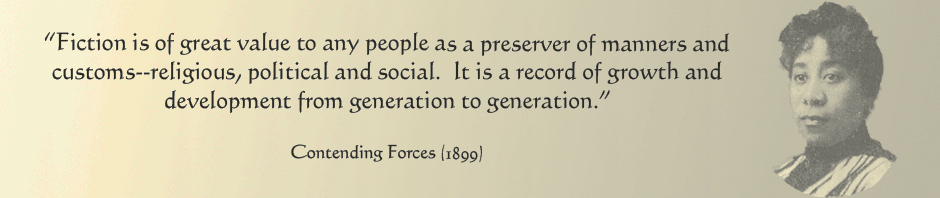
In 1900, the Boston-based Colored American Magazine launched its inaugural issue, convinced of the “immediate need of a Race Journal, otherwise than our current local periodicals.” Within a year, Hopkins’s zeal would direct much of the publication. She quickly became the magazine’s best-known literary contributor and one of the few Black women editors from the era. Hopkins continued to publish, lecture, and write after new management relocated the Colored American Magazine to New York City and severed the magazine’s relationship with the opinionated editor. Back in Boston, Hopkins wrote for the rival Voice of the Negro magazine, experimented with self-publishing, began her own imprint, and even made a brief comeback to magazine editing in 1916 with the short-lived New Era magazine.
Within the last decade, the digitization of the Colored American Magazine, the publication of a second collection of Hopkins scholarship, and the release of modern annotated editions of Hopkins’s serial novels have reignited interest in Hopkins’s life and writings. This work has opened up important avenues of research into Hopkins’s elusive biography and cultural work before, during, and after her years with the Colored American Magazine, cementing her role as one of the foremost African American artists and intellectuals of the early twentieth century.
This special issue will take stock of past scholarship and look forward to new research and perspectives on Hopkins and her milieu. We welcome proposals that examine any aspect of Hopkins’s work, especially in conversation with Hopkins’s own society, with past criticism, or with more recent theoretical/critical approaches to Hopkins. Some questions and prompts authors may consider include:
- Why study Hopkins now?
- How does Hopkins fashion herself as an early twentieth-century intellectual or race-woman, whether nationally or more locally within her New England milieu?
- How does Hopkins’s editorial work open space for other Black women writers, speakers, and activists during the early twentieth century?
- How does Hopkins’s complex compositional practices or use of multiple genres engage with concepts of race, empire, Indigeneity, and/or citizenship?
- What does Hopkins’s overlapping cultural work as a musician and performer, novelist and editor, and/or journalist and stenographer reveal about her sense of audience, authorship, or public engagement?
- How does Hopkins depict joy, hope, and/or pleasure during a time that historian Rayford Logan deemed “the Nadir” in The Negro in American Life and Thought (1954), that is, a period historically associated with racialized revanchism and despair?
Proposals should give the editors a sense of the work’s purpose within the body of scholarship on Hopkins, the project scope (including which works of Hopkins will be addressed; and/or which of her contemporaries the work places her in dialogue with), and the scholarly, historical, and/or theoretical approaches the work will take. Proposals should be in the 500 to 800-word range. Please include a curriculum vitae with the proposal.
We anticipate that finalized essays selected for inclusion in the special issue will have between 6,000 to 7,000 words, including notes and Works Cited. New England Quarterly also uses a modified Chicago style (footnotes; no use of Ibid) and any images will need to be supplied as TIFF or EPS files along with required permissions. Line art should be between 900 dpi (minimum) and 1200 dpi (maximum). For halftones, grayscale images should be between 260 (minimum) and 300 dpi (maximum).
The co-editors of this proposed special issue are DeLisa Hawkes (College of William and Mary), Courtney Novosat (Carnegie Mellon University), and Edlie Wong (University of Maryland, College Park). The best consideration date for all submissions is November 20, 2026. Please email your proposal and CV to Edlie Wong at edlie@umd.edu with the subject line: Hopkins New England Quarterly Special Issue.